Coaching 301: Bullpen Tracking using paper, PitchLogic and Pocket Radar

As I continue my evolution as a coach, my use of my tools, especially the PitchLogic ball, in bullpens has gotten more refined and the quality of the training and the information gained has increased dramatically.

Several weeks ago, PitchLogic hosted a webinar for ABCA, “What Pitching Data Really Means & How to Use It at the High School, College and Professional Levels“. It was a terrific webinar that delved into the experiences of pitching coaches at all levels. Truly enlightening, but not as focused on using the technology as I’d hoped. So, as a step toward improving our own bullpens, I’ve decided to share out how we’re doing it. I suspect this will provoke feedback and allow an iterative process to improve this for everyone.

Our environment

I’ve implemented the use of technology in our practices and in in-game bullpens over the course of the last 4 years. The pitchers involved are probably significantly younger than most PitchLogic users, ranging from 10-year-olds up to 15-year-olds. Since I started in Virginia and moved to North Carolina, no individual player has been in the system for more than 2 years. In 2024, it will be the first time that more than 3 of the pitchers involved has been tracked for more than a year. In every case, I’ve been the only person with regular access to the data (and the only one who understood it for most of that time!) For most of the time, I was the head coach. The past six months, I’ve been just a pitching coach and more focused on the process and data. I’ve also started sharing the spreadsheets with one of the players who envisions a career in engineering, since it’s good to have another set of technical eyes on the data.

The tools

For our bullpen tracking, we’re utilizing the Smart Coach Pocket Radar, F5 Sports’ PitchLogic ball, my own bullpen tracking sheets, Microsoft Excel, iCloud Notes, and the apps for PitchLogic and Pocket Radar.

The SmartCoach Pocket Radar was the first piece of technology that I acquired to help me coach my pitchers. While some of the old men that I play with contend that it’s not accurate (they think they throw 75mph while in their 60s), it shows readings matching the stadium signs when we use it at minor league ballparks. It doesn’t read speeds below 25mph, but unless you’re coaching 9u, that won’t be a problem. The best use of this is in-game to track velocity. We use it in bullpens for immediate feedback on the pitches. This is the velocity that we record on the bullpen tracking sheets.

The PitchLogic ball provides the detailed feedback on your pitches, to the extent that it provides far more information than you can use at first. I’m up to using 9 of the 23 columns of data returned after using it for 4 years. At first, we only used velocity, spin direction and arm slot. Then, we added more as we understood the use of each and saw patterns in them.

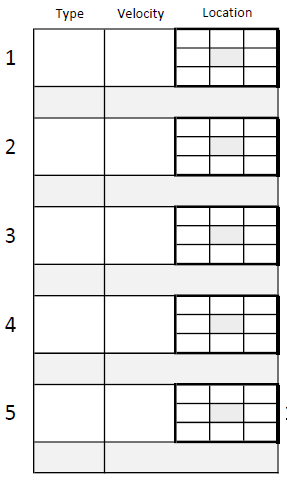
During the bullpens, we use my own bullpen tracking sheets. Each has room for 20 pitches, which is our standard bullpen. (MLBs PitchSmart guidelines have 20 pitches in a game as the max for pitching the next day, without rest.) For every pitch, we record pitch type, velocity, and location. The pitch location gets marked with an X and for pitches with movement, we draw a line indicating how it moved. There is a spot for any notes on a pitch. At the end of a bullpen session, we take a photo of the bullpen tracking sheet for our records and hand the paper copy to the player.

The data that gets collected by the PitchLogic ball can be downloaded as a CSV file (comma separated variable) and opened in Excel. Over the course of a season, I dump all the data for my pitchers into a spreadsheet and then create tabs for every player. Each of the columns that I use has formulas in it for highlighting good and bad results. By reviewing player data over time, it’s easier to see their improvement and find areas that need more work.

After the bullpen, we upload the photo of the bullpen tracking sheet to the player’s Note on iCloud. This way, all bullpen tracking sheets are in the same place, easily accessible and comparable. Any notes on the bullpen get added, then game stats, commentary or notes on usage get added to the same note. This single location for data collection and commentary ensures that guidance, practice results and game results can be understood.

Coach ‘Em All

Since we’re coaching 13u and it was fall, everyone threw some bullpens, and several players caught them. We discovered a couple of pitchers we didn’t realize we had – one of whom threw a 4-inning, one-run “complete” game win. As a Little League coach, I started every season believing that had 12 pitchers on the roster and you had to prove me wrong. I also started every season with a one or two catchers and finished with four or five, since everyone had to catch some bullpens and some ended up liking it a lot.

By allowing everyone to throw bullpens, you can discover those unknown pitchers and work on the arms of your fielders directly, rather than as part of a broader drill. When you’re coaching kids, you can’t know their potential. You can guess, but you’re likely to be wrong. The USA 12u National generally only contains 1 or 2 kids who make the National team in high school. Early growth and early success do not necessarily lead to continued interest or success. The move from the 60’ diamond to the 90’ diamond ends the youth baseball careers of many young all stars.

Setting up for the Bullpens

Depending on the facility, we might have a full bullpen with two mounds and two plates, or we might have an open space at the field that we have to lay out ourselves. It’s good to have a hard pitching rubber and a throw down plate and your measuring tape (or pre-cut string) handy when you don’t know what you’ll get.

Probably the most important thing to keep in mind is what happens when the catcher can’t stop the ball. I’ve lost a PitchLogic ball in the underbrush and had players chase another down a hill. If you can have a backstop, net or 60′ of open ground behind the catcher, that’s good.

Initializing the PitchLogic Ball

Before the bullpen, connect your PitchLogic ball to whatever mobile device you prefer. We generally get the best connection and display of data on an iPad. Once connected, you need to select the pitcher in the PitchLogic app so that their data is stored properly and, if they have the app, shared with the player. Lary Sorensen of F5 Sports gives a good intro to using the roster.

Remember, for any throw to be recorded, the PitchLogic ball needs to be held stationary for a half second. This reminds players to “make sure you don’t balk”.

Sometimes, we have the camera on for the bullpen and sometimes not. Usually when we do, it’s on the arm side behind the player facing home plate. This allows visual feedback of the movement and location. Sometimes, we have used arm side, 3 quarters in front to provide a different view of the pitch mechanics. When video is used, it’s best to have the iPad or phone on a tripod to keep the video consistent and to allow everyone to focus on the pitcher.

Setting up the Pocket Radar

For bullpens, I usually do not launch the PocketRadar app to record the velocity of pitches or to do the video. Sometimes, there seems to be interference on Bluetooth when I try using both the PitchLogic ball and the PocketRadar. So, I either hold it in my hand, connect it to the fence or have it on a tripod, always behind the pitcher. When there are no problems hooking both devices up with Bluetooth, I’ll put it on a fence using a Nexus Mount – either behind the pitcher or behind the catcher.

The most critical accessory you can get for your PocketRadar is a Power Bank. Relying on the batteries in the PocketRadar itself is a recipe for disaster. When using the app or just running continuously, the batteries die quickly. Better to have the power bank or plug it directly into an outlet at the field. (Often, you can plug in behind home plate, but I’ve never run across at outlet at the bullpens where we’ve practiced or played.)

If you can use the app, it allows you to tag which player is throwing the bullpen. When I use the app with video during a game, I will usually tag the pitches after the game, removing throws from the catchers and hits. Since you can set the threshold for minimum velocity on recording, you can usually prevent the app from recording catchers’ throws. This season, we’re going to start using it with GameChanger when streaming the games.

I wish that I had an application that would create pitch video season collections online for each of my pitchers so that we could easily review that online. If I had employees or interns, they might be able to manually execute that.

Timing

After players do their individual warmups (bands/weights/plyos), they will do their “every days”, throwing and fielding. This is typically followed by a team warm up, with team captains running the show. Coaches don’t necessarily intervene until 20 minutes into the practice. This allows us to validate the rest of our practice plan and finalize assignments, including the order of bullpens.

Each bullpen consists of 20 pitches and takes about 10 minutes of elapsed time. This includes the player throwing to loosen up a little, resetting all the technology and paperwork, some conference time after 15 pitches and assessment at the end. I keep thinking it can be two throws a minute, but there’s a lot of process around it.

Additional prep

Sometimes, we have a few players allocated to the bullpen session before they toe the rubber there. There are a number of additional tools that they might employ and tasks they might perform to help run a bullpen session.

The easiest tool for us to use is the CleanFuego. Our youth players of any age never have any trouble figuring out how to use the CleanFuego. When I pull it out in a group of old men playing baseball, they spend a lot of thought on how to throw it. It’s honestly as easy as the kids make it. When you throw a pitch with no gyro spin, the ball flies smoothly. When your spin direction is not right, it wobbles. Sometimes, it wobbles crazily. Kids adapt to it in 2 or 3 throws. It’s been great for getting them to impart backspin on their fastballs. So, when we have a couple of extra pitchers getting warm before their bullpen, we break out the CleanFuego.

We expect to start using our Core Velocity Belt this year and I think we will be integrating it into bullpens for warm ups at the start. Having just one Belt, we’ll start cautiously and expand it’s use as we get more comfortable with it.

We also occasionally have players do the tracking. This has ranged from having them just monitor and report on velocity to having them fill out the tracking sheets. As we train them in the process, I do expect that we will eventually be able to have players running the bullpens with coaches able to simply focus on coaching instead of dual-hat work as a data-recorder and coach. When we get to that point, we will likely also run more than one bullpen at a time which will greatly increase our data collection.

The Bullpen Tracking Sheet

Every bullpen is recorded, whether we have technology to provide velocity and other details or not. Simply tracking location, type of pitch and the number of pitches is going to useful over the long haul. In fact, if you don’t want to record or track velocity, just tracking the base data is going to help.

We start by filling out the top part of the bullpen tracking sheet. It’s straightforward to name the pitcher and catcher. Date is also an obvious one.

When I coached Little League, we’d have 2 games a week and I had a pitcher throwing a bullpen every inning. At the start of the season, that pitcher was always the one throwing the next inning. By the end of the season, with players throwing 2, 3 or 4 innings, some of those pitchers were just getting work in. Whether we had 1 or 2 practices in addition to the games, there was never enough practice time. By throwing a bullpen during the game, the player got focused attention and practice one more time. Some coaches will argue that the time is better spent in the dugout learning ‘situational baseball’, but we’d rather have them develop their physical skills whenever we can.

”Record By” was added when it was realized that if a player was marking balls and strikes in the bullpen, they might not have the same criteria as the pitching coach.

The initial version of the sheet didn’t number every pitch, so when left to untrained hands (parents or players) sometimes the pitches weren’t recorded in the order that we expected. So, every cell now has its number from 1-20.

I recommend new pitchers or fielders who may not pitch throw exclusively from the stretch. Learn one thing at a time.

For pitch #5 in this bullpen, the Changeup (CH) was thrown from the windup (W) and came in at 52mph. It started high and inside but finished in the top of the strike zone. Needless to say, this was good movement (GD MVMT). You can mark it any way that makes sense to you. I know my own notations have changed in the last year and will continue to evolve. For example, I’ll likely move that W over below the pitch type.

Not every bullpen is the same, but once the pitcher is loose, we have a quick conference on what the pitches are going to be. We might script 5 pitches of three types (FF, CH, CB) and try to throw 60% from the stretch. With some players, like me, it can 100% from the stretch, for simplicity.

The person recording marks the pitch type and whether it’s from the windup or stretch before each pitch, so everyone is on the same page.

At the bottom of the sheet, there is a section for Session Notes. We record the ball/strike ratio for each pitch type here, showing the velocity range (outliers in parentheses). We add comments about the bullpen session, such as a summary or praise or a cue that might be useful. Since the player gets this paper copy of the sheet, they’re likely to retain it to understand their own capabilities and progress.
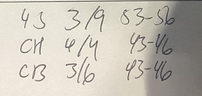
At the end of the session, we take a photo of the tracking sheet so it can be loaded onto the iCloud page for that pitcher.

iCloud Notes

We create an iCloud Notes page for each pitcher on our team. As pitch tracking sheets are created, each gets added to the bottom of the page. We add notes on the session, evaluations of the player and plans for future use (in games or in bullpens) at the top of the page. For both sets of information, the most recent image or text is placed at the top to allow quick reference.

Thus far, having them stored on the same page, but with images and text separated seems to provide the most value for us. Since we’ve just had this in use for a single fall season, we’re not yet sure whether to have new pages for new seasons or if all the data for a single pitcher should remain on one iCloud Notes page.

Finally

Hopefully, this gives you a good idea of the logistics, technology and paperwork to set up and record information about your team’s bullpens. I do expect to write more on the process and on what we’ve done when evaluating the data. For me, probably the greatest asset is being able to review objective data and recorded video of our pitchers, rather than just relying on my memory of how well their bullpens went.
Ever had your streaming camera overheat and fail? There’s a fix for that!

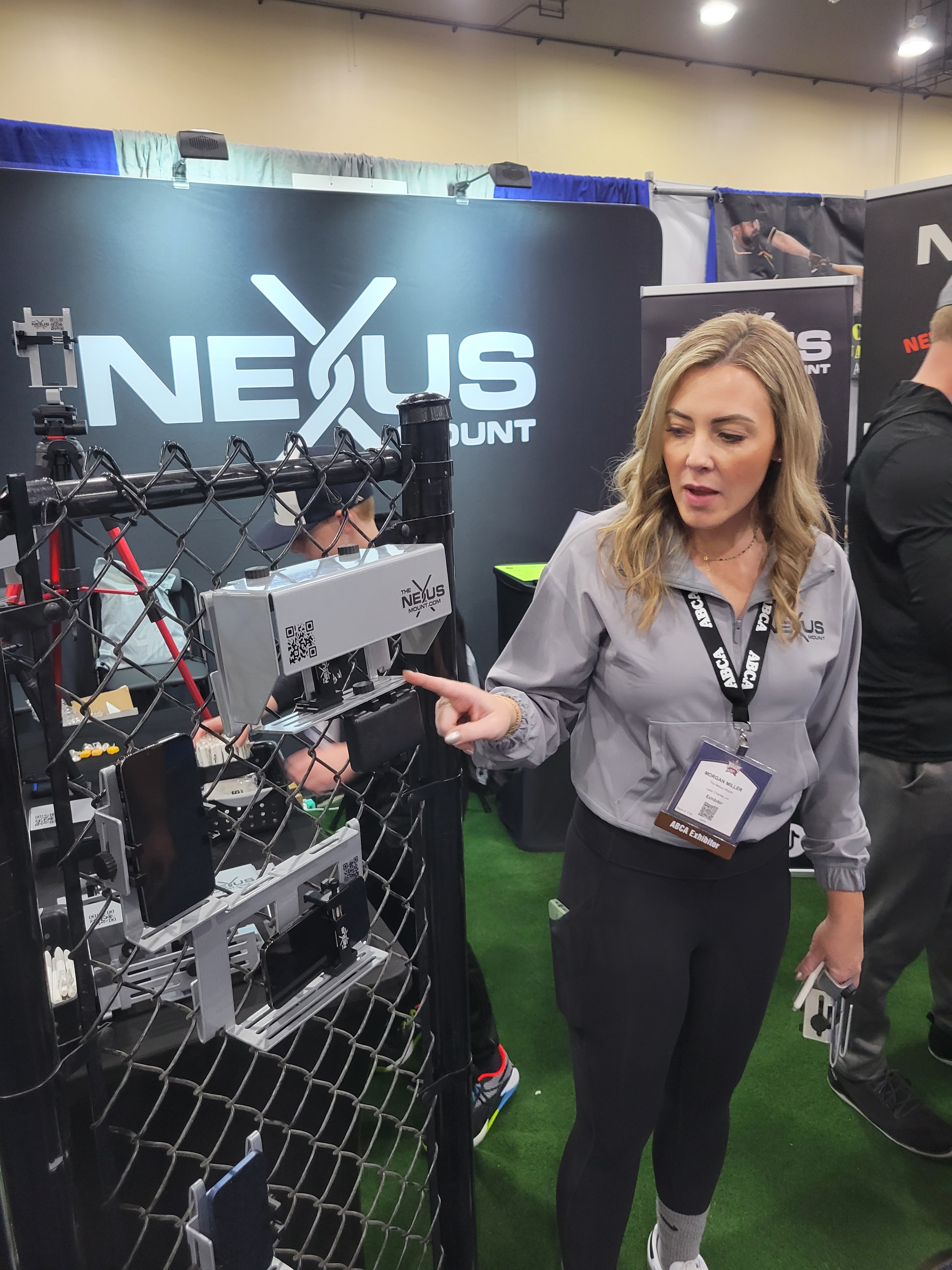
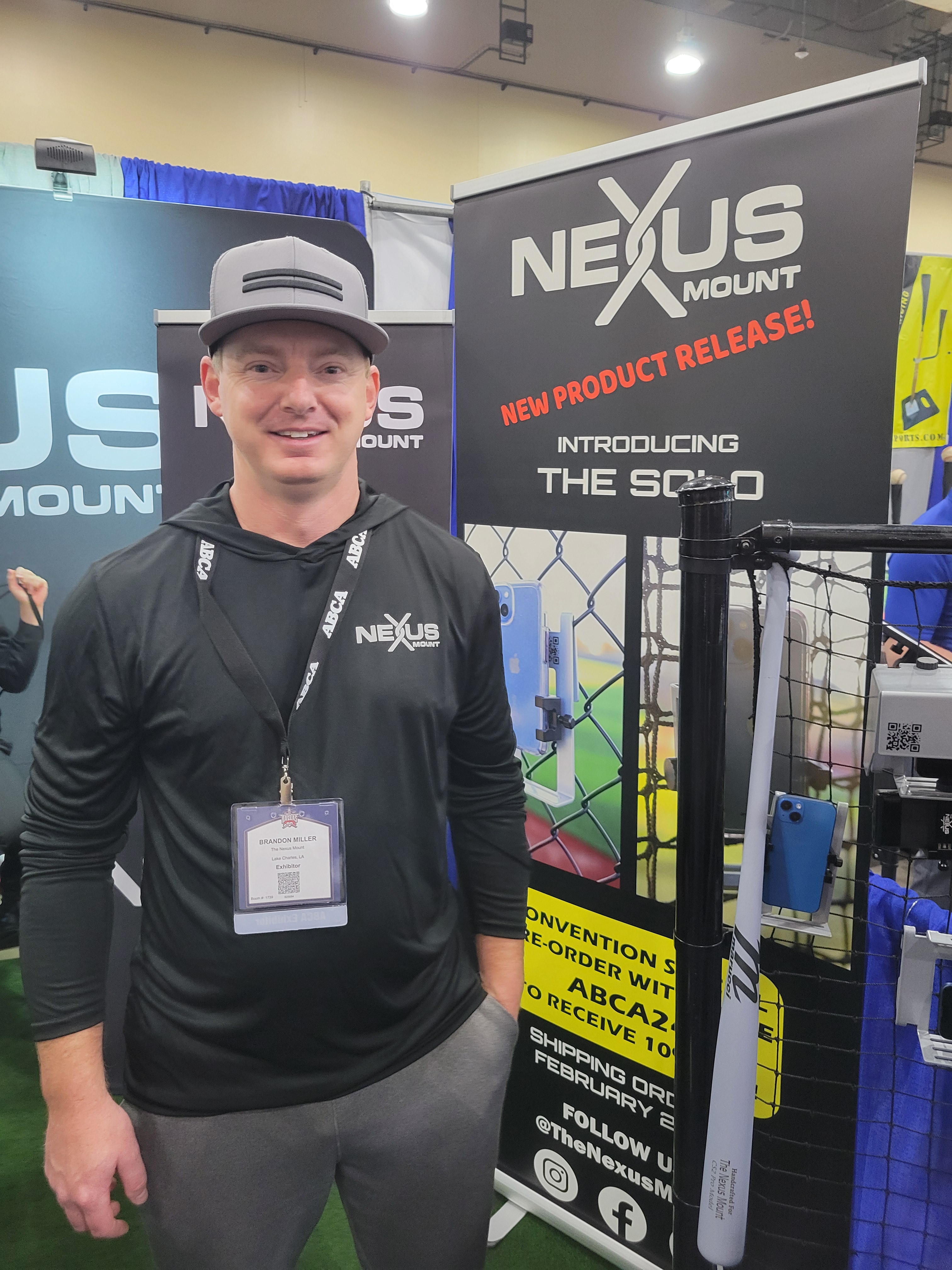
Walking the exhibit floor and Morgan Miller put some swag in my hands. So, I stopped. I’d walked by the Nexus Mount booth a couple of times. I thought to myself, “I have a tripod. Why would I need these fancy things?”

So, I stopped to look and she began to explain. I’m not the streaming guy on our team, but when I run our bullpens at practice, I’ve got my phone, my iPad and my PocketRadar, all of which might be mounted on tripods or on the fence with a universal mount. I had the tripods from when I did video of WWII veterans at reunions (like this funny Thanksgiving 1944 story), so I don’t know if the expense counts, but I have put more money into what I currently have then what it will take to replace it with a product that is more versatile, more reliable and easier to set up while also avoiding overheating.

Brandon Miller was frustrated with his phones and radars overheating, causing shutdowns and destroyed devices. He’s a problem-solver, so he built a mount that would shield his devices from the sun and secure them properly to a fence or net. People saw it and asked if he could make one for them.

In 2023, when they set their goal for selling some devices, they thought that 100 was a reasonable amount. They’ve sold 2000.

These mounts are made of aluminum, so they’re lightweight. They mount quickly and securely (you can check a video of that on their Tiktok) and you can get an ABCA discount if you order soon (code ABCA24!)

One of the great things about ABCA is running into a family-run startup, like Hit Them All (blog post: If you can hit a chickpea, you can hit anything) and Krato Sports (blog post: https://oldmenplayingbaseball.com/2022/01/06/abca-2022-first-day/). Whether you get to go to ABCA conventions or not, check them out!

1999 + 4 * 2026 = Prospects walking the floor

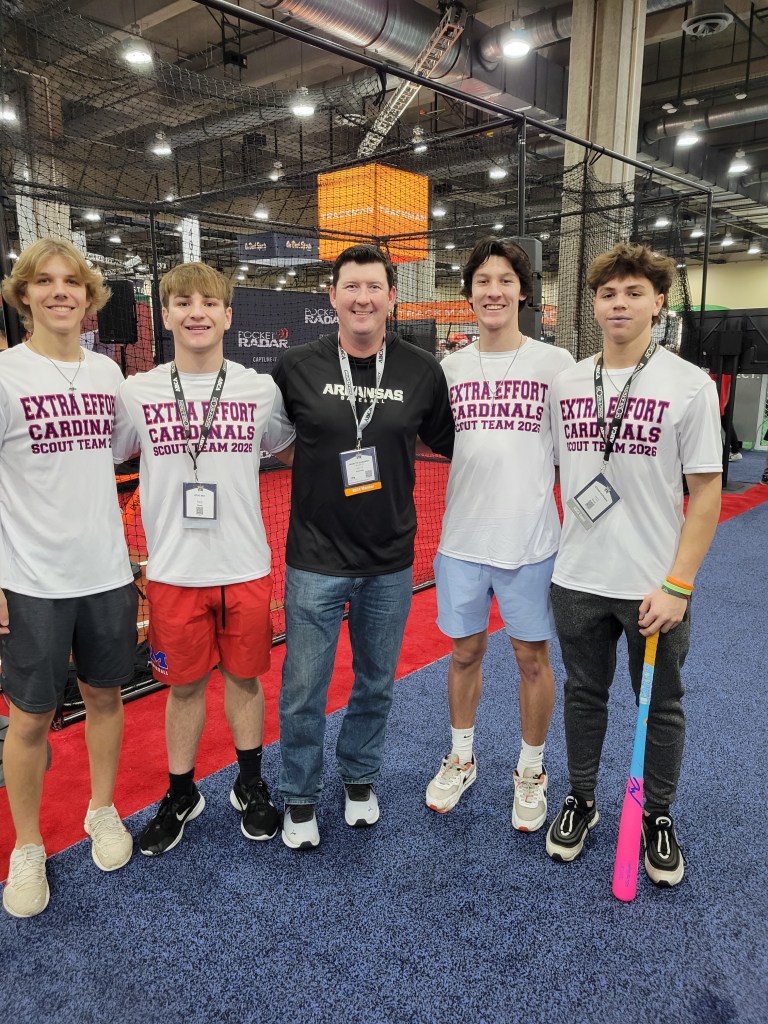
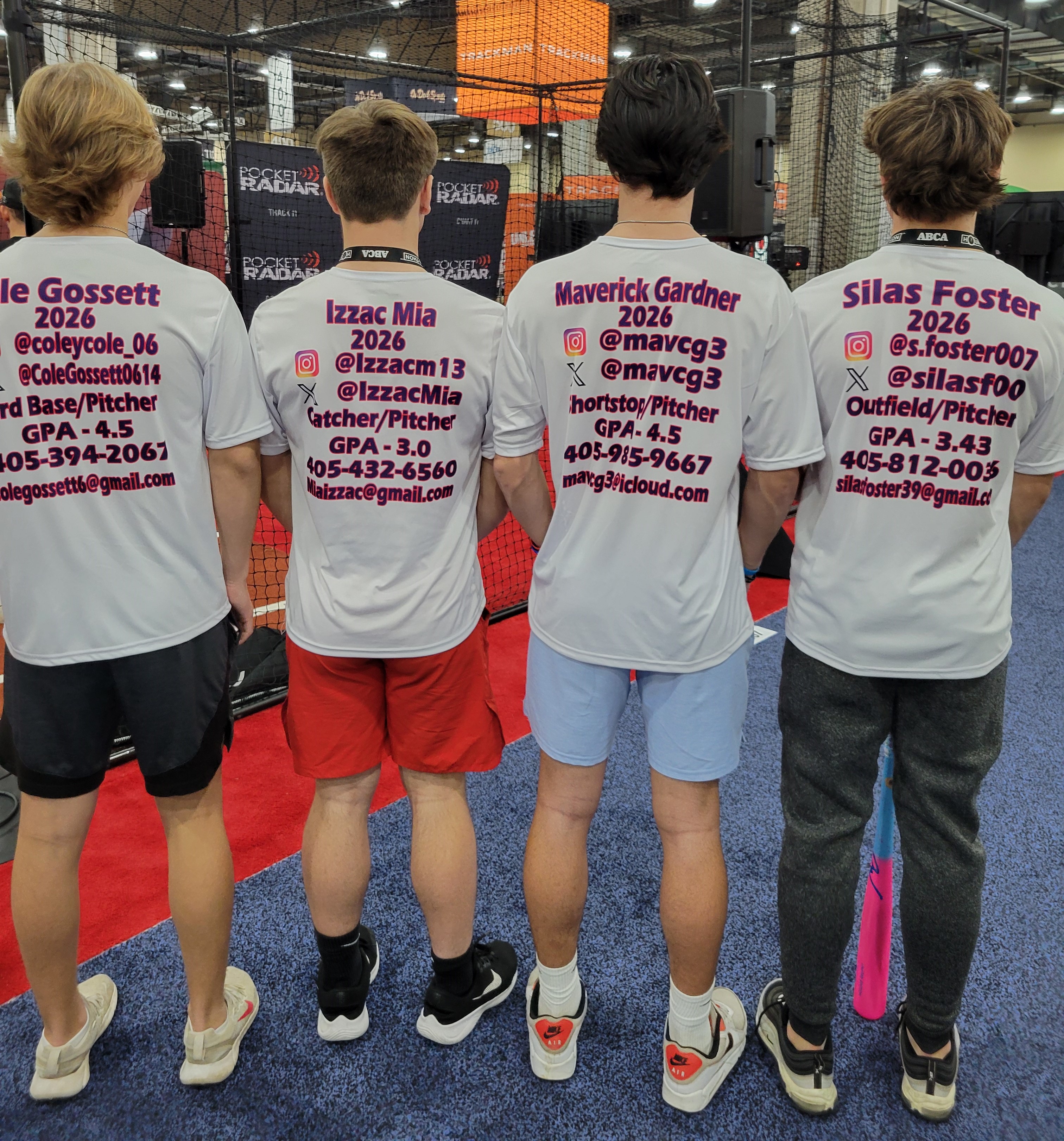
There were four athletic, driven young men walking the exhibit hall here at ABCA in almost matching t-shirts. I couldn’t miss them. They pounded the ball in cages where they could, threw it in cages where that was the goal, they went to every FUN spot on the Exhibit Floor. The joy of baseball was apparent and we need to share that.

Jarret Gardner (Moore HS, 1999) had a brilliant idea. He runs Extra Effort: Oklahoma City and he has four high school sophomores who need some exposure (Class of 2026). These Extra Effort Cardinals are all in white t-shirts, with the front identifying the facility and the back… providing how to reach them!

Coaching 203: Bullpen Pitch-Tracking Sheet

As I began using my pitch-tracking sheets, I found that I was feeling a little blind about the pitchers that I had warming up in the bullpen each inning. At my most organized, I had one assistant coach that served as the bullpen coach and I would ask him how the session went. Even though it was recorded using the PitchLogic ball, I wasn’t looking at any data when I considered sending in the reliever.

I had good data collection and some guidelines for number and type of pitches, I was only able to use it in retrospect to do an after-action review of the game and bullpen. I was able to discover and share insights with my pitchers – for example, that a high spin rate from one of my pitchers would coincide with a good outing. I didn’t have them use video because that got a little too complicated. I never knew how accurate they were throwing, other than generalities.

I came up with a basic bullpen pitch-tracking sheet. Room for 20 pitches and comments if necessary. It’s simpler than the pitch-tracking sheet for games, since there are no game details (count, runners, result) to worry about.

I’m now helping at practices with a 13u travel team and brought the sheets to a practice in which we did some short bullpens. The most important thing I learned was that it didn’t have enough guidance to how to fill it out. I had 4 pitchers and they rotated between camera, radar, pitching and the tracking sheet. It was a good session and it got me to improve the bullpen pitch-tracking sheet.

Sheet Header

In the header, it provides space to record your pitcher and catcher, as well as the inning and date for reference. It hadn’t occurred to me until our head coach, Sean Willingham, had a look at it that it was REALLY important to know who filled it out. It will almost always be our players recording the data and some players will record the strike zone far tighter or looser than others. If you don’t have them mark down who recorded the session, you might interpret the results incorrectly. It also forces some accountable when recording.

Pitch cells

There are four sets of five pitch cells to allow 20 pitches in a bullpen. While that’s more than I had the 11-year-olds throwing, a little extra seemed merited for older players. For bullpens that happen at practice, 20 pitches feels good for me, even when we’ve got the 14u practicing with us. If they’re throwing a bullpen instead of pitching, it would probably be useful to use two or more sheets. Then, have the pitcher take a break after each sheet, as though he was sitting while his teammates hit. Pairing pitchers on bullpens like this is a good way to simulate game usage.

Pitch type follows the little guide in the upper right (if you prefer FF and FT for 4-seam and 2-seam….) and the next big box is the velocity. Then, the important one for in-game bullpens is the 9 cells for the pitch location. The middle is the strike zone and I prefer they use an X to mark the location, being as granular or vague as their understanding merits. When recording pitches that have good movement, you can always use an arrow to show where it started and where it ended. At the bottom of each pitch cell is a grey box in which a note could be made, like “GRT MVMT” or track the virtual count (2-1, 0-2, etc).

Let me know if you find this useful or if you have editing suggestions. I am probably going to have the good folks over at Always Grind 365 print me some books full of them before the next ABCA. If you’ve read this far, you obviously like recording data on paper like I do, so make sure to check out their Pitcher’s Notebook and Catcher’s Notebook. I use both for myself when I play and will be working with getting our 13-year-olds to try them out this year.

Rounding third and headed for home…

Gene told Fred he was going. Fred told Glenn that Gene was going. I set up outside. It was a perfect pitch – just outside and a bit above the waist. I stepped forward and grabbed it. (They tell me my foot was on the plate and the batter would’ve hit me with a swing.) Solid catch. Smooth transfer. Good throw. Gene’s just too darn fast.

On Wednesday, our nine-inning game was the “wood bat game” of the week. That doesn’t affect me as a hitter because I’m always swinging lumber from Phoenix Bats. It does affect a lot of other players, changing those long drives into shallow fly balls. Having a single game on Wednesday and letting it be a wood game should allow everyone a little recovery time. After all, the average age this week is 66.

Gene Lee is probably the fastest runner down here at Ponce de Leon spring training. He always goes on the first pitch and doesn’t care if everyone knows it because… it’s next to impossible to throw him out with arms that were in their prime 30-40 years ago. Once he’s on second, he’s in scoring position and he’s always going to try to score. Here’s video from his first scoring attempt, which Steve Liddle asked me to share. Joe Bauer behind the dish.

I’m curious about the consensus, since my opinion is biased. He did this again, later in the game, while I was catching (after the steal in the first paragraph) and it was … so cool! I know I didn’t get him, since the throw was just up the line. I don’t know if it hit him or if I reached the glove out to stop it. One conspiracy theory has Gene grabbing my arm to prevent me from catching it, but if he did, I didn’t notice! Sadly, I don’t seem to have that video.

Over the fall, I spread the word in Asheville about this week of spring training. It worked and I got Joel Huggins to sign up. While Joel hasn’t been able to break the logjam at first (what team that’s over 50 doesn’t have 7 first basemen?), he’s done well in the outfield. Unfortunately, during the outfield specialty sessions on Tuesday, Joel had a fly ball hit his throwing hand before hitting his glove. So, he’s got a badly bruised (if not broken) ring finger on his throwing hand. In batting practice, he said that every time he made contact, it stung so much, he saw stars. There was a play in right field in which he charged the shallow fly ball and it worked out for us – while the ball dropped, Fred was able to scoot back from second and get the runner from second at home. That gave us a runner on first with 1 out and we escaped the inning with a well-timed double-play. When I later made a mistake, Joel reminded me how I needed to let it slide and that everything would work out.

Adrian Rosati started the game on the mound for Stu Clyburn’s team and despite rarely topping 37 mph, he really frustrated us. You don’t need to throw hard down here. You just need to throw strikes. He walked me and I got the first of my two steals on the day. (Yes, my legs are reminding me that catchers shouldn’t steal, especially mid-week.) The score teetered back and forth a little, settling to 7-6 in the late innings, when there is no run limit.

Doug Milman has been a godsend for us in the field. He and John Gardner have split innings at shortstop and I believe there might only have been one error there. Their fielding and throwing has been awesome. We don’t always end up with the out at first, but that’s Ponce baseball for ya. One time during this game, Doug was out in centerfield and he looked out of position to me. I waved him in the direction I wanted, but I didn’t need to. Doug coaches baseball and he moves like a gazelle. So, where he lines up in the outfield is guided by experience and understanding of the game, aided by his ability to get to most anything.

With Gene’s speed, we knew we were at risk once he reached base. As noted above, he stole second despite our best efforts. So, when the next batter hit the ball, Gene got on his horse and motored around third.

I lined myself up in front of home plate, giving him a path to the plate and I saw that look in his eye. The ball was coming in and I thought we had him… but the ball was just behind him and he was safe. I tagged him after I picked up the ball, then threw to second to try preventing the extra base. Unfortunately, we didn’t get that out. It was such a thrilling play, I enjoyed it despite the outcome. I love this game!

The score finished at 9-6 because we just couldn’t find a run late in the game.

I think I’m 6 for 16, with a few RBIs and two steals. I’ll have to look at the score sheets today to get a better handle. It doesn’t matter much how I hit if I can be consistent behind the plate. This week has been huge in getting comfortable back there and I know I’ll be able to handle catching regularly now. Also, it doesn’t matter because this is so much fun regardless of the outcome.

Tight games and tense moments

On Tuesday, we started the day against JR’s (John Russell) team. His teams are always good teams. I was going to list ways in which they’re usually good, but it’s in almost every aspect. Only a few players are good at most things, but each player he has can boast of one above average skill. That’s true of most of the players down here. One might wonder how someone who’s around 80 can compete with players 20-30 years younger. If you hit the ball hard or throw strikes or can play catcher, you don’t have to move fast or have another skill.

Every year at our spring training, we have a day on which we do “specialties” and the professional coaches do some skill training for the players. Most years, we haven’t had a catching session because the turnout would be pretty low. This year, they had one before the morning game, run by Stan Clyburn. Since I know I’m going to be catching a lot and probably not pitching at all, I had to miss Rick Knapp’s pitching session. One of the best aspects of coming to Ponce Spring Training is that these pro coaches add so much knowledge to the team – they give great instruction and they learn our quirks over the years. It’s what they do when they’re with their minor and major league clubs, so it should be no surprise. I’ve never heard of that kind of skill work when teams go to a tournament – you just play.

In our games, we always have run limits in all the innings except the last one. This avoids destroying the arms of the pitchers. When you have at least 58 innings you need to cover with pitchers and you start the week with only 4 pitchers, having those innings end mercifully is quite important. Each of our four pitchers has to pitch every day in order to cover 14 innings.

The games on Tuesday bounced back and forth. Holding a team scoreless for an inning is probably a bigger deal here than anywhere else. 3-run innings are not rare, but scoreless ones are. The game against JR got rough in Fred Jaffke’s second inning on the mound. His control started to deteriorate and I should have gone out on the mound to give him a chance to reset. Pitching can be a finicky thing and Fred will do fine in his next outing.

Sonny Hill kept racking up the RBIs. The hitters in front of him have done a good job of getting on base and it’s paid off. Not everyone runs fast or throws strikes, but they have a talent. Sonny’s is driving runs in.

We managed to squeeze out the morning win with some shutdown innings from Glenn Strachan. It’s been a delight catching for Glenn as his location is very good and the velocity exceeds the rest of the pitching staff. Sometimes, we get the pitch we watn, where we want it and they still hit it, but more often than not, we’re getting weak contact or swings and misses. Those misses are increasing as the week goes on.

Jerry Spitz started the second game and we weren’t great in the field behind him. The estimates of the number of outs we gave them with errors in the first innings were around 7-8 outs. That makes it hard to win. Jerry did get into an argument with the umpire when an opposing player stepped into the plate to avoid a curveball that hit him… over the plate. Jerry turned in 3 innings with the lead passing back and forth between the teams, with one or the other being one run up.

A late add to our team was Rick Kramer. He’s a little speedster and used to be a “vacuum cleaner” in the outfield. There might be a step lost that prevents him from getting to all the balls he used to, but he does well. His bat speed is exceptional and he’s been scooting around the bases for us, scoring critical runs. When the second game went into extra innings and Rick started the inning on second base, I knew we had that run.

In the extra innings, Glenn felt that his hand was doing well enough (recovering from a line drive off it last week) that he took his turn at bat. Mitch Orcutt was pitching the late innings and kept right on going in extra innings. Mitch sometimes comes inside and, sure enough, he hit Glenn on the first pitch. I went up next and got hit on the hand on the second or third pitch. It’s the hazard of pitching inside and, for me, the hazard of crowding the plate. As a result, we took the lead.

On a bloop that landed at the edge of the grass and bounced to Bill Murray, the opposing team’s runner on 2nd tried to score. Bill made a nice throw, which I caught a few feet up the line to beat the runner by a large margin. Those extra innings are a jumble in my head of what happened when and how.

With the heart of their lineup coming up in the bottom of the 9th, Glenn shut them down and I caught strike three to end the game. Hard-fought and nicely won.

So you want to be a catcher?

“All right, so who are my catchers? Joe, I know I’ve got you.”

Silence. No one raises their hand, despite two others having been assigned to the team with the thought that they are catchers.

“I’d like to catch a little.”

So, at the end of the first day, I’ve caught nearly as many innings in one game as I caught last year. I think I caught nine innings last year – never more than three in a day. Today, I caught 8 innings. The last four in both games. It was awesome.

So, I’m down at Ponce de Leon Spring Training, playing at historic Terry Park Sports Complex down here in Fort Myers. At the end of January every year, the Ponce de Leon league from the Washington DC area hosts a balanced tournament and training week. Six professional coaches to coach the 6 teams (including Darrin Garner, who is taking a week away from pre-training with the Arizona Diamondbacks to coach my team). Steve Liddle (former bench coach with the Twins and Tigers) runs the camp for us. They divide all the players into relatively equal teams (with provisions for who wants to play together) and we play 8 games over 5 days (2 Monday, Tuesday and Thursday). There are trainers in the clubhouse to handle preventative care and injuries. Everyone gets a locker and can have the clubbie do their laundry. It’s a far different experience from Roy Hobbs or other tournaments, and also far different from fantasy camps. It’s all about playing baseball – learning a little and playing even games – rather than focusing on retired ballplayers or only on winning.

I thought I was coming in here to be a utility player – catch a few, pitch a few and play everywhere in the field. When it was revealed that two of the guys that the league thinks are catchers only did so because their teams needed it, I was both scared and excited. I’d been doing a hundred or more weighted while walking my dog every morning and trying to find a moment to do additional reps (without weight) all day to get over 200 squats. That preparation has paid off.

I picked up a Catcher’s Notebook from Always Grind to use and evaluate whether I can have my youth catchers use them when I coach. So, once I settled with Joe Bauer that we’d split the innings, I went to each of our 4 pitchers and took notes on their pitching repertoire and preferences. I had thought I’d try something like this when I was going to catch in a tournament for a team last fall (canceled by the hurricane down here) but having the structure of the notebook is much better. I’m still a newby here and wouldn’t have guessed what to be thinking. After a day, I’m pretty sure that it will also be a good thing for 12-year-olds to do. They may not have a grasp of all the nuances, but it gets them thinking critically about how the game went, how they performed well and what they need to work on.

The first game of the day was a little brutal. We ended up giving up 3 runs in four different innings (3 run limit in all but the final inning) but I got to work with three of our four pitchers. Glenn Strachan is a tournament pitcher that was allocated to our roster to give us an ace. He locates his pitches extremely well and gets the hitters to hit it where we want it. Being that we’re all old men, that sometimes still doesn’t result in an out. Bill Murray (no, not that one!) came in and pitched a couple of innings and some of his pitches are honestly unhittable. That should work out well this week as long as he’s around the strike zone. Fellow Michigan State alum and Washington Nationals grounds crew member, Fred Jaffke, finished the game out. With a final score in the morning game of 12-4, we were hanging our heads a little.

In the second game, Jerry Spitz started the game with Joe behind the plate. After 3 innings, Glenn and I cam in as a battery. We all managed to keep the game close and when we held them scoreless in the top of the 7th (we’re playing 7 inning games), we eked out a 1-run victory to set us even at 1-1. There was far more timely hitting in this game and, in particular, Sonny Hill banged a hard line drive up the middle that brought in 3 runs while the centerfielder chased it down

I had a reasonably good day at the plate, going 1 for 2 in the first game with one of the 4 RBIs and 1 for 3 in the second game with one RBI. Behind the dish, my blocking was very good and my receiving was good enough. I did have two runners steal – one when I bobbled the pitch and another when my throw was a little off-line. The hard throws in the warmup when “coming down” should help deter much thievery. I did field a few balls near home that resulted in outs and ran down a runner who tried to steal home on a walk. I’m very happy with how I played behind the dish.

We feel like we escaped by getting a split on Monday, and will come back hard on Tuesday to make our drive for the championship.

If you can hit a chickpea, you can hit anything

I’m a sucker for a good story and especially for a good story behind a new business in baseball. Last year, I got to meet Rick Weaver and Justin Kuhn, who started Krato Spoorts (we will have a follow up this weekend!) and this year, I met Felix Fernandez.

Growing up in the Bronx, Felix would hit chickpeas to improve his hitting skills. When he got the chance to create a tool to make that easier for players to try, he started FLE-Innovations. So now we can all try to hit them all!

I was leaning in and Angel Jorge, who’s working for Felix part-time, saw my interest and built on it. The little machine fires bio-degradable balls for you to hit – each the size of a chickpea! You don’t need a partner. You don’t need a field or a net. You could be in a tiny yard just big enough for you to swing in, or next to a chain link fence (hook the machine to the fence!) or just about anywhere. The balls disintegrate on impact and biodegrade over team.

They’re running a $50 off special, so the machine and your first 120 balls are $199.99. You can get another 400 for $25 and 800 balls for $40.

Felix is here in Booth #2812 at ABCA 2023 and there was a swarm around their booth. Get in there!

While you’re there, congratulate Felix on his baby (his wife isn’t here so she can care for their 9-month-old).

Coaching 102: Little League Batting Orders

One of the most daunting challenges the first time Little League coach faces is… how do I arrange my batting order to be the most effective and useful to my players?

The Good News: It’s not that important at first

For a team of 8-year-olds, you don’t need to maximize productivity to win. Your two goals are to help your players have fun and help them learn how to play baseball. Winning is incidental. If they have fun playing AND get better, it doesn’t matter what the score is. So, don’t agonize over who your leadoff hitter is and which player to bat cleanup. Productivity in a coach-pitch game approaches randomness. Any ball that is put in play could result in a run and in some hilarity in the process. Concentrate on two things: having them swing hard and cheering the effort.

Equality of opportunity: The Continuous, Rolling Batting Order

One of the biggest challenges facing the kids who end up at the bottom of the batting order or not in the starting lineup in a 9-player batting order is getting enough plate appearances to get better. A Little League team gets better as a group far faster if the “bottom” players work their way up to being “league average” players than if the four best players improve incrementally.

In a team of 12 players, having all 12 players in the batting order is a “continuous” batting order. Every players bats, regardless of whether they’re in the field or not. This is far less complicated than a 9-player batting order and avoids confusing players and coaches with “substitutions”. I’d suggest that you use a continuous lineup until you reach 12u in Little League if your league allows it.

The odd word in my suggestion is “rolling”. In a rolling batting order, the batter on deck at the end of a game leads off the next game. The order of hitters is always the same, but it simply starts with whoever was on deck last game.

Benefits

There are a few benefits to a rolling lineup:

  • Equal plate appearances: Every batter is going to come to the plate nearly the same number of times over the course of a season. Absences will be the only thing that affects how many times a player comes to the plate.
  • Improvement for all: Since the players who sit at the bottom of a normal order don’t get as many opportunities to bat, they have fewer opportunities to improve. By getting them an equal number of at bats, they should improve far more quickly than if they got one less at bat than the top of the order in every game. The last batter, in particular, is likely to get 20% fewer plate appearances than the first batter. That last batter needs those plate appearances to get better.
  • Reduction in stress for players: A player’s spot in the lineup is going to affect their personal opinion of their play and put stress on them. Those at the top of the lineup might be helped or even hurt by being at the top of the order, especially if the order isn’t the same every week. Getting moved up or down is going to occupy their attention and may cause “concern” in their parents. If the batting order is the same all season (or most of it), no questions arise.
  • Reduction in stress for the coach: One less thing to think about. One less thing for parents to be concerned about. You’ll always know who your leadoff hitter is for the next game.

Drawbacks

What are the drawbacks of using that continuous, rolling lineup?

  • People are going to think you’re crazy. It’s not what they see in the major leagues, college, high school or even most youth leagues. If criticism bothers you, you probably shouldn’t be coaching because no matter what you do, someone will criticize it.
  • It does not maximize run scoring potential in the first inning. If you start with your 8th best hitter and the 12th hitter is the “cleanup” hitter in the first inning, you might not see the results you’d hope for in the first inning. On the other hand, once the game is rolling, you’d have the same randomness about who is leading off each inning anyway.
  • Your best players don’t get more plate appearances than the rest of the team. I think that development of the entire team is going to give everyone more plate appearances and those bottom of the order hitters stop being automatic outs and play “league average”.

How should it be structured?

With the continuous, rolling batting order being established when you play your first game, it’s important to be happy with the order you’ve chosen. Should it be random or skill-oriented?

Random

When coaching at the beginning levels, it’s hard to tell before you’re played any games who is going to hit well other than a few players. You’ll likely have a couple that parents and growth rates have prepared a little better than the others. You’ll likely have players improve at vastly different rates. I’ve used an alphabetic batting order to remove any glory or stigma from where a player hits in the rolling batting order. Probably the biggest drawback is sometimes your best player is preceded or followed by a player that hinders them. A slower runner in front of a player that could hit for extra bases or having the next batter be a player who grounds out or strikes out frequently. You can’t rearrange these orders, so random might be frustrating.

Skill-oriented

By taking player skill and expected performance into account, you can make portions of your batting order more likely to produce runs than the rest. I like to construct it so that there are two parts that are productive, rather than stringing together all of the lesser players. Since you might have any player hitting leadoff, I prefer to avoid more than two players that are more likely outs. As the season goes on, the certainty of unproductive performances by those players is going to go down, which should smooth things out as well.

Phases of the Season

I follow the guidance of the Driveline youth baseball development course and divide my season into three phases: On-boarding, Exploratory and Performance. Each of these phases is normally about a month in our March to May (plus a few days of June) schedule.

In On-Boarding, we’re trying to get everyone acclimating to how we organize practices and games. We also do our “baselining” to determine the skills everyone has started with, so that we can measure and track them over the season. By tracking them, players can see their improvement over the course of the season even if game performance is more random. During On-Boarding, we determine the batting order we’re going to use in a continuous, rolling manner.

In the Exploratory phase, it’s all about trying new things out and helping the players improve. In these first two phases, we really emphasize improving effort and ignore box scores and game results. Winning is nice, but it’s not our focus. We want to get better and have fun doing it.

Depending on the level of play, we might continue to use that continuous, rolling lineup in the Performance Phase. The first few seasons that they play baseball, it’s probably reasonable to simply continue rolling the lineup over from game to game. This past season, with my 11u team, we reset to the top of the order for our playoff games. I kept the order almost the same and it still contained all of the players, but it started at the top. (One player was moved down from 5th to 6th, but moved back the next game as I realized I shouldn’t try to fix something that wasn’t broken.)

Proposal

This has worked for me over a few seasons. I tried it with a 13u team, but it’s hard to tell if it worked or didn’t because we had so many absences that the lineup felt random every game. It was fine for 10u and 11u in Little League. Last year, we went 4-6 in the regular season, 0-3 in pool play (yikes!) but then swept our three playoff games to the championship. The “bottom of the order” was productive in those playoff games. There were no “easy outs” on our team and some “dead” innings by the other team. In the championship game, we knew we just had to survive the top of their order and cruise through. Those three games in the playoffs weren’t very close.

If you’ve got a young team and especially if it’s your first season coaching, I’d love to have you try it and provide feedback.

ABCA 2022 First Day

This is my first big baseball conference. I’ve been to IT shows and worked the All Star Game Fan Fest, but NOTHING prepared me for this. As a baseball guy walking the trade show, you could stop at EVERY booth and find something interesting or useful. You’d also get to talk to some great people.

Brilliance in bat design

A number of years ago, I wanted a flared-knob bat. I’d been using my Phoenix Bat regularly, but when I’d do an hour-long batting cage session, I’d develop a line of blisters at the knob. So I asked them to design me a bat with a flared knob. Some major leaguers were using them already and Axe had just come out with it’s first bats (only flared on one side). When I stopped by the booth today, Brad Taylor recognized my name. He was the one who designed my bat back in December of 2015!

Now, Phoenix has a dozen flared-knob bats on the display table. If you’re at the ABCA, go check THOSE bats out if you do nothing else. Tell Brad he’s a genius because… he is.

Weather

Chicago is mighty cold. I asked a bicycle cop if it was better to ride slow to avoid the wind or fast to create body heat. He told me “slow and steady wins the race” because riding hard makes you sweat and that sweat makes you COLD! I took the train in and met up with a few other conference attendees at the Clark/Lake stop. We conferred on which train was the right one and we nailed it. Unfortunately, the walk from the Cermak/McCormick Place station to the convention center was long and COLD. Three guys from Virginia, Texas and Florida might have been a little overmatched, but we survived.

Ground-breaking new tool made in the USA!

I’d let my Little Leaguers use my sleeved weight on their bats when I accidentally had it in the team bag, but it was just too heavy for them to do anything but be funny. I’ve been learning more about overload and underload bats, so wanted to start incorporating them into our practices. That gets a little too pricey for a coach buying gear out of his own pocket.

Rick Weaver (@Rweaver23) was talking to Justin Kuhn, father of one of the players he coaches, about an idea he had for bat weights. Justin had a friend with a machine shop, so the came up with the Krato Bat Weight. By being just above the hands, you get the benefits of the modern overload bats but can use it on any bat, use it in live hitting, against machines or off the tee without worrying about breakage or other nonsense.

They come in a variety of sizes and I went ahead and bought the beginner pack (10-ounce, 15-ounce and 20-ounce) with the heaviest one intended for MY personal use.

They’ve been in business for… 30 DAYS. Check their website and stop in to see them. Booth #671.

Getting 56 on your radar gun?

There’s a fantastic new version of SmartCoach out from Pocker Radar for the iPhone. While that won’t be available on Android for a few months, I did spend some time with one of the hardware engineers, Michael. He did a great job of demonstrating the new software and I’m pretty excited about that new version. Apparently, three new Android guys have joined the team and releases will be much more in sync in the future.

So, the biggest tip I got today was on the phantom 56 and 118 mph readings that randomly appear on my Pocket Radar. Those are from cell phone towers! Or some other electronic interference. Nothing wrong with the equipment, just a known anomaly. The new version makes it easier to set the velocity range for your Pocket Radar. Fortunately, none of my Little Leaguers can throw 56. In my men’s league, I think I’ll take advantage of the fact that I have two radars and put one at 36-55 and the other at 57-75.

Great first day

Despite that fact that I’m an introvert (an OUTGOING introvert), I met a lot of people today and really got into some great conversations. Because I learned a number of years ago that I’m an outgoing introvert instead of just “weird”, I know that I need to find a quiet spot and time to recharge. I’m doing that in my room right now as I write this. I’m recharging the energy used spent talking to people (the introvert part) so that I can get back out and be the dynamic guy I love being. So much to learn, so many people to talk to.

If you’re here, maximize your time. Get the most out of it. If that means spending an hour away recharging, do that. If it means diving into every open session, do that. Whatever you do, go talk to folks on the showcase floor. Even if you don’t think it’s something you’d be able to use, talk to them and find out! You might learn something and make a friend in the process.