As I began using my pitch-tracking sheets, I found that I was feeling a little blind about the pitchers that I had warming up in the bullpen each inning. At my most organized, I had one assistant coach that served as the bullpen coach and I would ask him how the session went. Even though it was recorded using the PitchLogic ball, I wasn’t looking at any data when I considered sending in the reliever.
I had good data collection and some guidelines for number and type of pitches, I was only able to use it in retrospect to do an after-action review of the game and bullpen. I was able to discover and share insights with my pitchers – for example, that a high spin rate from one of my pitchers would coincide with a good outing. I didn’t have them use video because that got a little too complicated. I never knew how accurate they were throwing, other than generalities.
I came up with a basic bullpen pitch-tracking sheet. Room for 20 pitches and comments if necessary. It’s simpler than the pitch-tracking sheet for games, since there are no game details (count, runners, result) to worry about.
I’m now helping at practices with a 13u travel team and brought the sheets to a practice in which we did some short bullpens. The most important thing I learned was that it didn’t have enough guidance to how to fill it out. I had 4 pitchers and they rotated between camera, radar, pitching and the tracking sheet. It was a good session and it got me to improve the bullpen pitch-tracking sheet.
Sheet Header

In the header, it provides space to record your pitcher and catcher, as well as the inning and date for reference. It hadn’t occurred to me until our head coach, Sean Willingham, had a look at it that it was REALLY important to know who filled it out. It will almost always be our players recording the data and some players will record the strike zone far tighter or looser than others. If you don’t have them mark down who recorded the session, you might interpret the results incorrectly. It also forces some accountable when recording.
Pitch cells
There are four sets of five pitch cells to allow 20 pitches in a bullpen. While that’s more than I had the 11-year-olds throwing, a little extra seemed merited for older players. For bullpens that happen at practice, 20 pitches feels good for me, even when we’ve got the 14u practicing with us. If they’re throwing a bullpen instead of pitching, it would probably be useful to use two or more sheets. Then, have the pitcher take a break after each sheet, as though he was sitting while his teammates hit. Pairing pitchers on bullpens like this is a good way to simulate game usage.
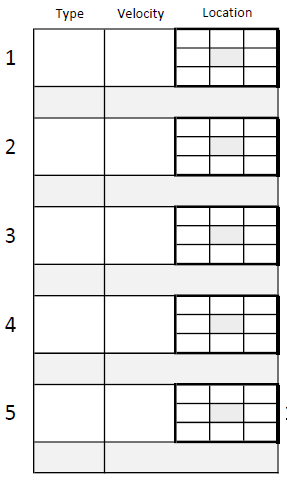
Pitch type follows the little guide in the upper right (if you prefer FF and FT for 4-seam and 2-seam….) and the next big box is the velocity. Then, the important one for in-game bullpens is the 9 cells for the pitch location. The middle is the strike zone and I prefer they use an X to mark the location, being as granular or vague as their understanding merits. When recording pitches that have good movement, you can always use an arrow to show where it started and where it ended. At the bottom of each pitch cell is a grey box in which a note could be made, like “GRT MVMT” or track the virtual count (2-1, 0-2, etc).
Let me know if you find this useful or if you have editing suggestions. I am probably going to have the good folks over at Always Grind 365 print me some books full of them before the next ABCA. If you’ve read this far, you obviously like recording data on paper like I do, so make sure to check out their Pitcher’s Notebook and Catcher’s Notebook. I use both for myself when I play and will be working with getting our 13-year-olds to try them out this year.
 Old Men Playing Baseball