Charting Consistency in Pitch Movement

As I dive deeper into data, the one thing I become more convinced of is that consistency is the most important thing for a pitcher. If you can get your delivery to be consistent, you’re going to be able to reliable put the ball where you want to. The most important thing in pitching is throwing strikes, and consistency makes that easier.

So, Sean and I had a bullpen with one of our guys this week. I got PitchLogic data on his pitches and I pushed it into the Python visualization code I’ve been working on. Among the charts it creates is one for movement by pitch type. On that chart, it creates a box that’s where about half the pitches would be if he threw with this consistency. So, for some players and some pitch types, it can be very large and for others, very small.

For these four-seam fastballs, that box is about 4 square inches. You can see most of his pitches are near it and a third of them are in it.

If Player One can get all of his four-seam fastballs to move 15 to 17.5 inches vertically and around 8 to 9 inches horizontally, he’s going to be consistently hitting his aim point.

Our goal isn’t for all of our pitches to put their pitches in his box, but, rather, that he consistently throws his four-seams this way. If he does, he can change his aim point and dominate hitters.
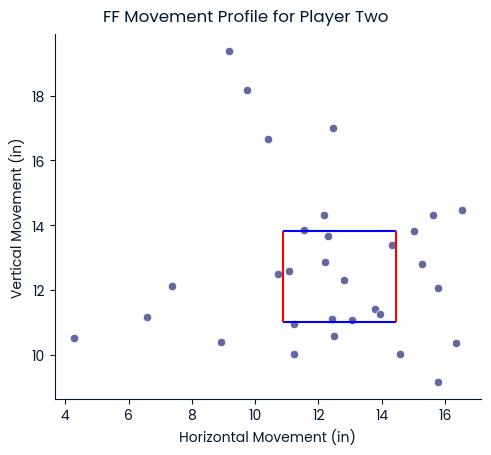
Every player is going to have a different box. Here’s a younger player whose box is about 10 square inches. As he gets more consistent, there will be fewer outliers and his box will get smaller (and he’ll throw more strikes).

I’ve only recently come up with this box – so recent that I don’t even have a name for it. It’s from the inter-quartile range of the movement data, so I could call it the IQR box, but that would get everyone asking why it’s called that instead of what it means and how it’s used. Maybe I could call it the MCB – Movement Consistency Box?

The PitchLogic ball auto-tags the pitches by type. I love this because it points out when players are not doing what they intend (throwing a cutter when they want to throw a fastball) or when they are mislabeling their pitches (throwing a cutter but calling it a fastball). The unintended variety tend to be younger players, while the mislabeling tends to come from high school players.
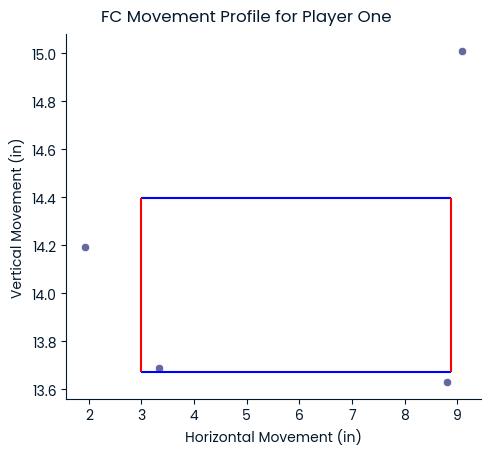
For our bullpen the other night, four pitches go auto-tagged as cutters. All four would have been down and to the left of the MCB for his four-seam fastballs. So, these wouldn’t have gone where he thought they would go. He also lost velocity on each of them. So, that high, hard inside pitch ends up slightly slower and out over the plate. Yikes!

Is it due to incorrect grip? Or a bad release? Is it lack of pronation? I honestly don’t know, but I know it’s something we’ll investigate and work on. I also need to check location on these pitches – time to get back to the code!


I’m not including any of the visualization posts in the Coaching Courses because they don’t really fit. They’re a bit esoteric and not really what you need to start coaching. It’s fascinating stuff, though.
Visualizing Pitching Data

I’ve been dumping my PitchLogic data into spreadsheets and manipulating it in HCL Notes databases, but I wanted to see some ‘visualizations’ to evaluate the data a little better. A picture is worth a thousand words, right? Or it “a pitcher is worth a thousand words”?

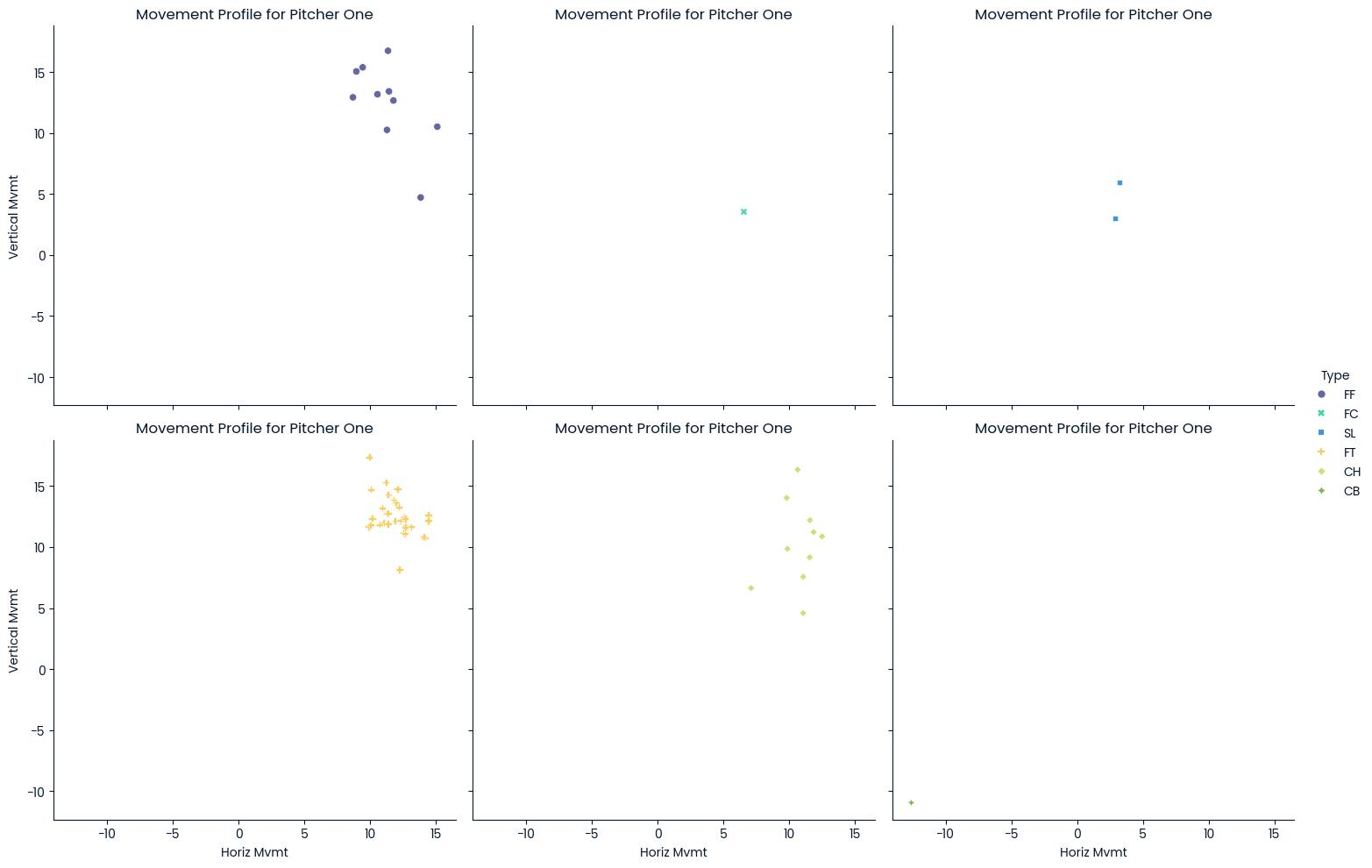
Within the PitchLogic app, you can get the vertical and horizontal movement for a single session. When you go look at your session reports, you see a little more. So, I’d used ChatGPT to help me create some visualizations from my downloaded data. Here’s a sample, showing those movement profiles by pitch type. This is only from about 50 pitches, so it looks interesting, but is a little less-than-actionable.

As you know from Coaching 203: Bullpen Pitch-Tracking Sheet, I’m collecting location data on my bullpen tracking sheets, so I decided to create some charts and graphs using that.

Now, that gives a very good visual impression of where the pitches are going. Fortunately for us, this is our hardest throwing pitcher and we’re going to have him for two more years. One of the things that pops out about this is that he’s missing high (1-2-3) more than he’s missing low (7-8-9) with 34% of his pitches being high and just 6% being low. Oddly, in this sample, nothing inside or outside at strike zone height. That could be just because it’s a small sample or might point out bad data collection (we might be categorizing those inside and outside pitches as high or low as well.)

The good thing is that I can also break this down into different pies for each pitch type, but the lack of data doesn’t make that real useful right now. When you have it, it can really bring home what the quality of the pitches really is.

I learned something new as well. I might have seen a boxplot a few times, but I never understood them. This uses statistical methods to place the velocity of the various pitches he’s thrown. Now, you must keep in mind that these are to auto-tagged pitch types. For any of you who are coaching young teens, you’re going to notice that how the PitchLogic ball tags the pitches is not always what the player intended to throw.

I’ve been telling other coaches that one of the things we need to work on with youth players is “grip discipline”. Most of them grow up with no instruction in how to grip the ball at all. Sometimes, they get instruction in how their fingers ought to be aligned, but rarely do they get instruction in how to line up the laces and their fingers the same every time. When I first started coaching Little League, I sent a Dad out to the mound to talk to our pitcher. He came back and said, “He was holding the ball with three fingers!” That was when I first realized that a lot of Dads and assistant coaches also need coaching and instruction.

Technology, and the PitchLogic ball in particular, give us a lot of numbers. As any old baseball guy will tell you, the only number that actually matters is balls and strikes. I don’t focus on how to improve those myriad numbers, like a player’s spin rate or velocity. The goal is consistency since moving the ball in a consistent way makes it easier to throw strikes. So, we look at how consistent is the arm slot, or whether the release makes it a cutter instead of a fastball. Then, we use the numbers as a gauge for ‘how consistent’ the pitches are.

How can you do this?

If you have a PitchLogic ball, you can get your data. Just go to the “hamburger” down in the lower left in portrait mode or upper right in landscape mode and then click on “Get CSV Data”. This will let you pick the dates for which you want data and then email you a file. You can drop it into ChatGPT and start asking it to make you some visualizations.

I plan on writing about the technical details on my software development blog, so for those who love that stuff, revisit here in a few days for a link!

Meeting New Vendors at ABCA 2025

Every year, I hunt around the Trade Show floor trying to find innovative products and interesting vendors. I want something useful, and a story to go with it. This year is no different!

RITEND Bat Weight

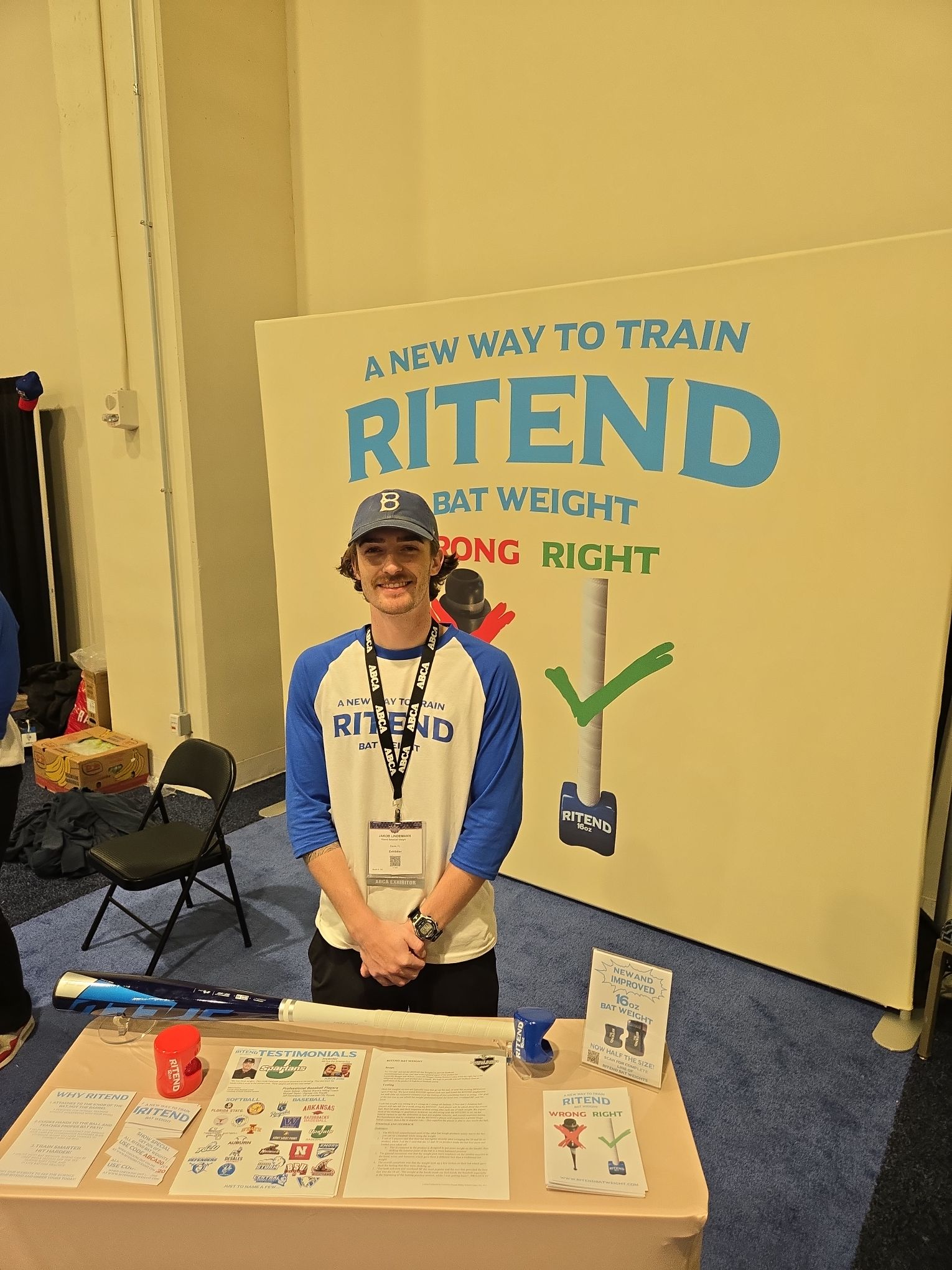
Almost hidden in the corner of the Trade Show Floor is RITEND Bat Weight, staffed by new President, Jakob Lindemann, son of the founder, Skip Lindemann. Skip always stressed getting your hands through the ball when coaching his son and his teams. So, he developed a bat weight for the right end of the bat – the RITEND bat weight is down on the knob. Jakob’s recent engineering change to the weight was to go from aluminum to steel, allowing a more compact weight. It’s easy-on, easy-off and is worth a look to see if it’s the tool for you. See them in Booth #152, in the corner.

Dobre Breaking Ball Trainer

20250103_1343301553623602344846560

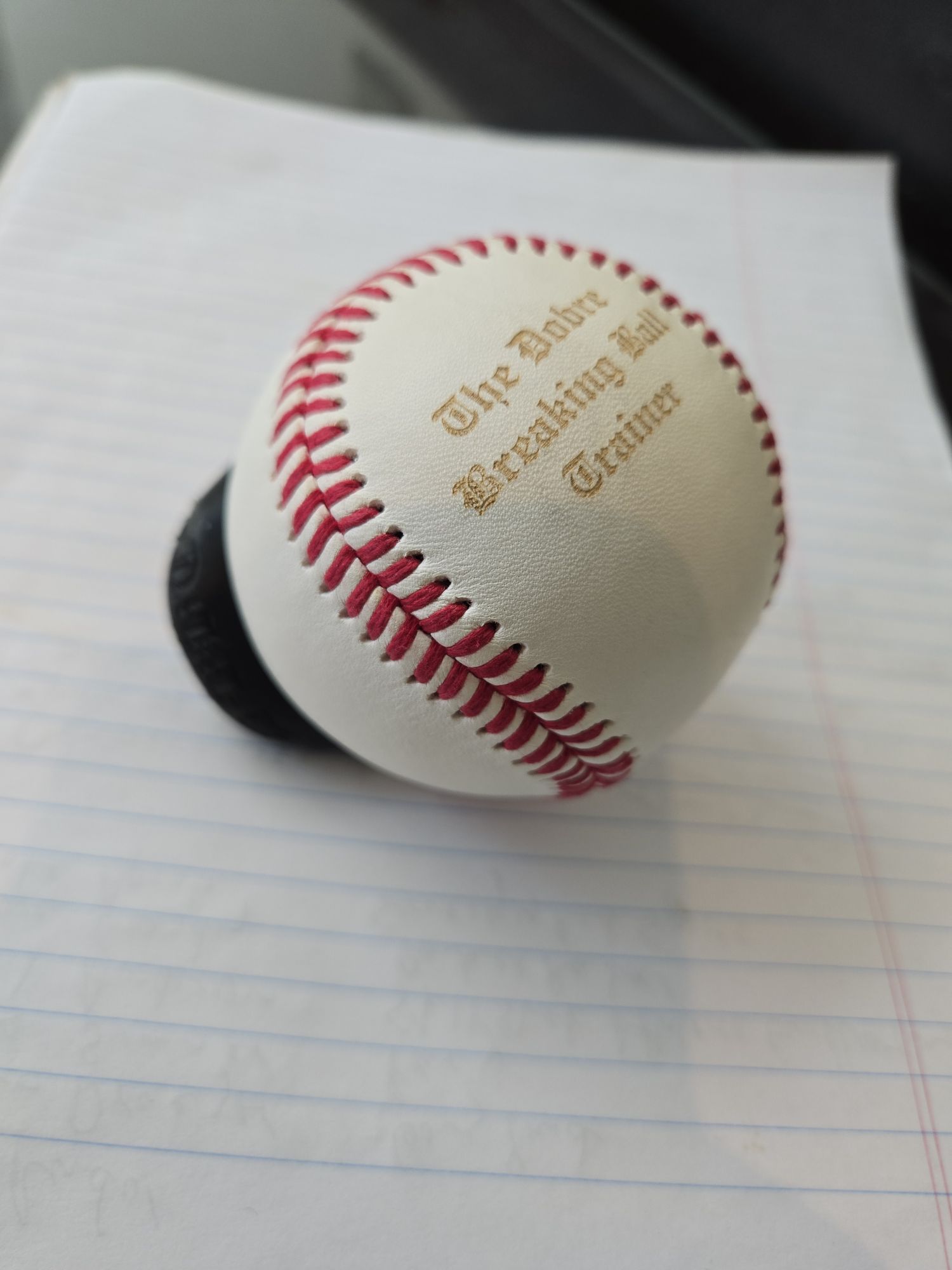
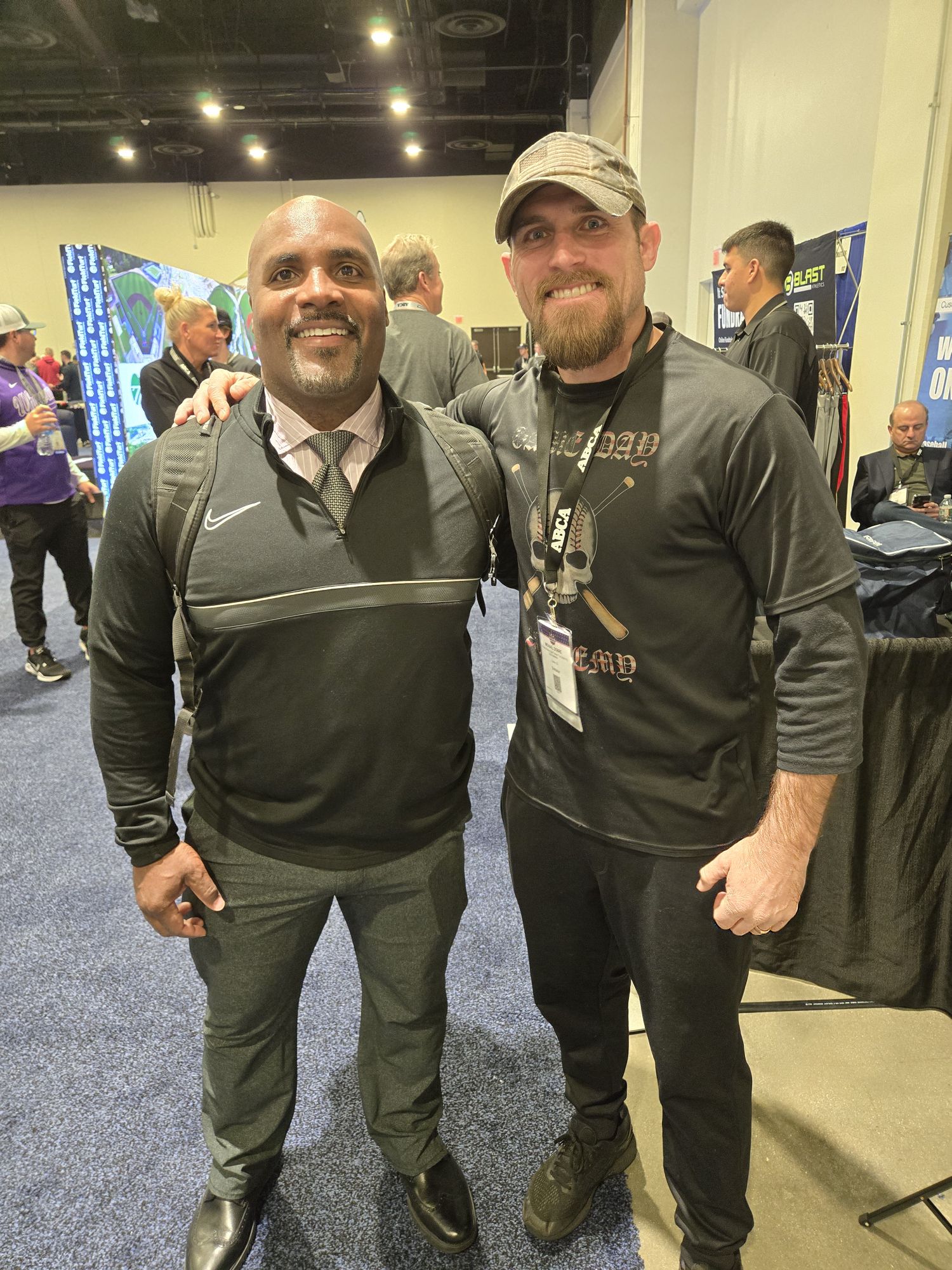
Back in Asheville, at Bob Lewis Ballpark, I ran into Michael Dobre, who was showing and selling his Breaking Ball Trainer. One of the things that sparked my interest was that Mike is a veteran. He was an Army Ranger (airborne-qualified, too) who was in the 2017 Best Ranger Competition (one of 53 teams of truly qualified soldiers). His trainers are baseballs with a ridge on them to allow players to learn the grips and how to throw the pitch with the best movement. He’s in Booth #118

20250103_1101201542383234793589012

I spent some extra time, talking to his Dad, who served in the Marines. I always carry my coin for Jordan Haerter, so I shared with him the story of Haerter and Yale in Ramadi – the “Six Seconds” speech that General Kelly gave. It was great to be able to share that story and talk about developing youth both through Scouting (I was a Scoutmaster before I was a baseball coach) and through baseball.

While I was there, Juahn Clark, who is the ABCA Trade Show Director, happened by to share how much his daughter enjoys using the trainers that Mike developed for softball. Designing his softball trainers involved a lot of research and Juahn testified that they both work AND are liked. He noted that a good tool that players don’t like might as well not exist.

Trade Show Coaches Social

Don’t forget, the Trade Show floor will shut down for an hour to give them a break before reopening for the Social Hour at 4:00pm. Your drink tickets are attached to your badge!

ABCA 2025 First Day

As the coach of Randolph-Henry baseball (VA), Josh Barmoy, said, “Off to Disney World for baseball coaches” when tweeting about his ride in. It truly is Disney for us.

Registration was a breeze once I figured out where it was (top floor of the atrium) and then I hit the Trade Show. As I’ve noted in prior years, like with ABCA 2022 First Day, there is a LOT to see. I’m committed to visiting as many vendors as I can and sharing their stories, especially the small ones!

But first, a story

In my final season coaching Little League baseball here in Alexandria before we moved to Asheville, I got a new player, who had never played baseball before. Our Young E. was a relatively good-sized kid, but there were probably no sports in his background. His arms were obviously strong and I knew there was potential.

When we brought out the PocketRadar to find out how hard everyone threw, Young E. couldn’t throw hard. He sometimes threw one that registered 25 mph or so, but it was in a random direction. Sometimes, in practices leading up to the season, he would get distraught with bad directional control and think he wasn’t throwing any harder.

By the beginning of the season, using both PitchLogic and PocketRadar to track his progress and provide encouragement, he was able to throw it 30 mph. By the end of the season, he clocked one at 41.8 mph and it was in the direction of his teammate and catchable.

Three years later, he’s getting ready for another baseball season. We showed him that the OUTPUT of his efforts was improving so that by the end of the season, his OUTCOMES were far better.

Why bring this up?

This afternoon, the CEO/Co-Founder of PocketRadar, Steve Goody was on the Expo stage talking on a panel about Integrating Evaluation Technology in youth baseball. On the stage with him, Neil Anderson from SkillShark Athlete Evaluations was explaining how his software helps organizations evaluate players using PocketRadar and eliminate all the paper-to-PC tracking of evaluations. Then, Alex Sumner of Fargo Youth Baseball and Jordan Draeger of GoingYard Baseball talked about how easy it is, how it provides objective feedback to players and helps shape player development.

Both PocketRadar and Skillshark are doing their share to “democratize the data.” By making data transparent to the players and parents, they encourage the players, show them their progress and give them guidance on how to get better. As with our own Young E, retention is much improved.

Great Conference, Like Always!

I’ve got my list of vendors and I’m stopping in to see a broad variety of them to hear what everyone has to say. I’m an Outgoing Introvert, so I use my outgoing times to meet as many as possible, especially the little ones or the folks who have no customers in front of them at the time. Then, I use my introvert times to share my experiences with all y’all. (Since I live in North Carolina now, “all y’all” isn’t awkward to my companions.) I do have some revisits planned (I spoke to Brandon and Morgan at Nexus Mount, so will have an update to share!)